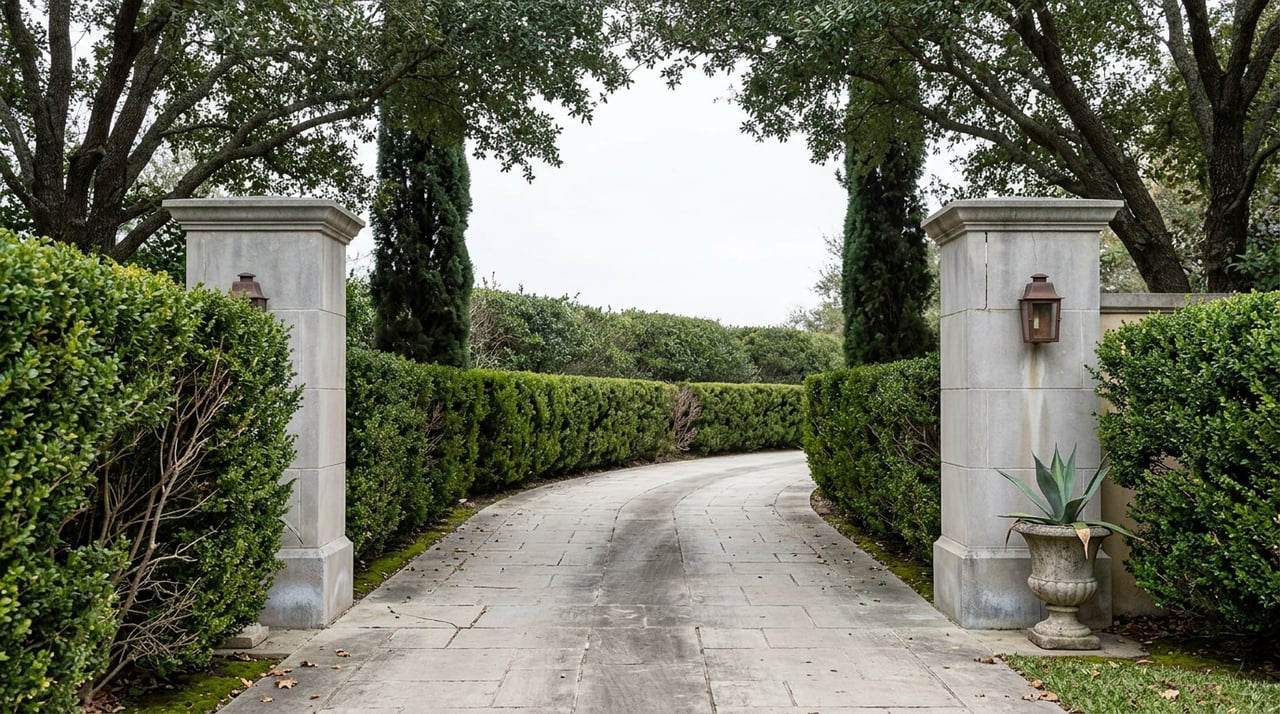
Drive north on Beverly Glen from Sunset and the East Gate announces itself the way it always has: two stone piers, a bed of clipped hedges, and no one stationed there to ask for a name. Nothing stops the car. Loop over to Bellagio Way and the West Gate does the same thing, with a UCLA entrance visible across Sunset Boulevard. Both intersections read as a threshold. Neither one is a checkpoint.
That gap between the impression and the mechanics says something real about how Bel-Air actually runs. The plantings at both gates, along with the small triangles and traffic islands scattered through the neighborhood's older streets, aren't kept up by the City of Los Angeles, and they aren't billed to a homeowners association, because for most of Bel-Air there isn't one. They're tended by a club of volunteers that has done the job, with one wartime interruption, since 1931.
The intersection everyone assumes is guarded
The confusion is understandable. When Alphonzo Bell opened the original 128-lot tract along Bel Air Road in the early 1920s, centered on that road and the five streets branching from it, Saint Pierre, Saint Cloud, Bellagio, Copa De Oro, and Nimes, he stationed a uniformed guard at the entrance to check in visitors, reportedly a first for any community in the region at the time. He also wired the hillsides for underground electric and telephone service before most of the city had it, planted thousands of trees along the new winding streets, and set deed restrictions requiring a minimum construction spend of $20,000, enforced by a design committee built to keep the architecture in low masses and horizontal lines rather than anything ornate. That committee still exists today.
The guard didn't last. What remains of the original checkpoint idea is the gates themselves, sitting on public streets that any car can pass through freely. The one place in Bel-Air where a guard booth still operates is Bel-Air Crest, a separate HOA-governed community built later and walled off on its own terms. The historic East Gate and West Gate, the two most people picture when they picture Bel-Air, have run on stonework and plantings alone for a century, not security.
A luncheon, not a municipal contract
The person responsible for the plantings was Bell's wife, Minnewa. In 1931 she held a luncheon at her own estate, Capo di Monte, for a group of friends and neighbors, and by the end of the afternoon the group had agreed to form a garden club. The first official meeting took place the following month at the Bel-Air Administration Building, the same structure that operates today as the Hotel Bel-Air. Dues were two dollars a year. Lunch ran a quarter to seventy-five cents.
The club's early scope went well beyond hedges. Annual flower shows in the Administration Building drew thousands of visitors. Members organized public tours of Bel-Air's residential gardens, some running past ten at night. They also scattered wildflower seed across undeveloped hillsides around the growing community, treating the bare slopes as part of the same project as the finished gardens closer to the road.
The years the flowers stopped
The flower shows paused entirely during World War II. Rather than fold, the club redirected itself, forming the Bel-Air Red Cross Auxiliary and raising the money to buy the Red Cross a van. Members also adopted the wounded servicemen at the Sawtelle Veterans Home, bringing flowers to the wards and decorating the dining halls, chapel, and board rooms for the holidays. The contrast is worth sitting with: the same club now known for hedges and holiday garlands spent four years running wartime relief instead, then picked the trowels back up when it ended.
What the club is actually structured as today
Ninety-five years on, the group is still doing recognizably the same work, scaled to what a finished residential neighborhood needs rather than what a growing subdivision did. According to the club's own filings, its stated purpose is to maintain the beauty of Bel-Air and promote civic beautification, alongside educational programming for members. It meets on a set calendar, October through May with a summer break, plus one annual meeting in June.
One organizational detail is easy to miss and says a lot. Charity Navigator lists the Bel-Air Garden Club as a civic league rather than a registered 501(c)(3) nonprofit. That distinction means it isn't held to the same public reporting rules as a formal charity, and it doesn't chase the kind of grant funding a registered nonprofit might. It runs instead on membership dues and whatever the membership decides to spend them on, the same basic model it used when two dollars a year covered it. What that currently funds, by the club's own account, includes:
- Ongoing upkeep of the East Gate and West Gate plantings
- Christmas decoration of both gates every December
- Maintenance of Bel-Air's street triangles and traffic islands
- A members' calendar of speakers and private tours of gardens and architecture, in Southern California and beyond
That last item is where the club still most resembles its 1931 self. Recent programming has included a members-only talk from Ariana Lambert Smeraldo, founder of the Melrose Avenue floral business Lily Lodge, who marked her own shop's twentieth anniversary by walking members through her design process. Her client list includes LACMA and Chanel, a sign of the register the club still operates in nearly a century after Minnewa Bell's luncheon.
The centennial the club didn't have to explain
Bel-Air's other long-running civic institution, the Bel-Air Association, has been active since 1942 and is headquartered directly at the East Gate, at 100 Bel Air Road. Where the Garden Club tends the ground, the Association has spent recent years documenting the story behind it. It commissioned a five-hundred-page book, Bel-Air: The Centennial, marking one hundred years since Bell filed the original 1923 tract map, drawn from photographs, brochures, and materials pulled from Bell's own historical records. Author David Silverman gave a lecture on the book's research at Robinson Gardens in February 2026, walking through a history the Garden Club has, in a sense, been living rather than writing down for the past nine and a half decades.
Set the two institutions side by side and the pattern is plain. Neither one is a government body, and neither one is the kind of homeowners association that shows up on a title report. Both are volunteer organizations that outlasted the developer who founded the neighborhood, still doing the jobs he left behind: one keeping the story straight, the other keeping the gates in bloom.
What this means if you already live behind them
None of this changes what a house here costs or what it takes to buy one. It does explain something a longtime resident might have wondered without ever chasing down the answer: why the same two intersections have looked cared for in exactly the same understated way for as long as anyone can remember, with no maintenance contract or assessment fee attached to it. The answer isn't a city department or a management company. It's a club with dues, a calendar that runs October to June, and a habit, unbroken since 1931 except for one wartime detour, of showing up.
For anyone curious how a neighborhood this quiet stays this consistent, or weighing what it takes to live behind one of these two gates, Jonah Wilson Partners can walk through the details that don't make it into a listing description. Contact Us.