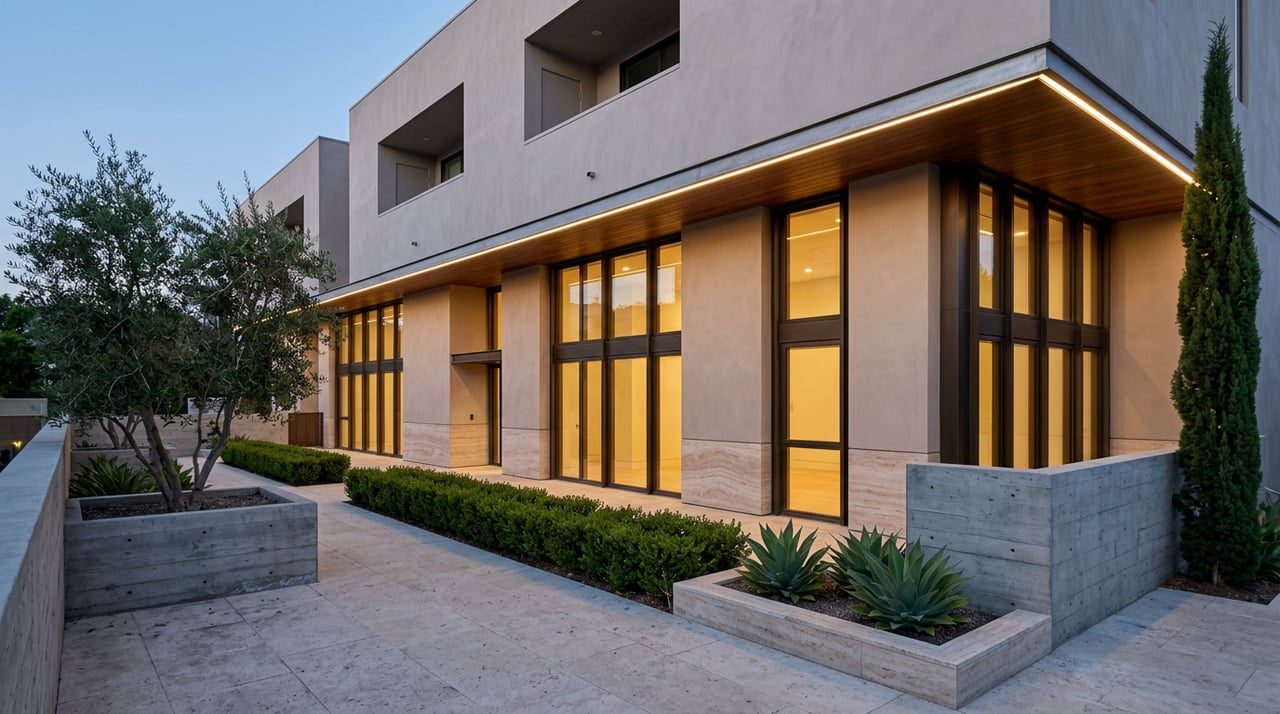
The excavated lot at Melrose Avenue and Almont Drive has sat empty since June 2021. For most of that time it held rainwater instead of tenants, which is how it earned its nickname among neighbors: Lake WeHo. This summer the site's developer introduced a plan cutting 225,000 square feet of planned office space down to zero and replacing it with more than three times the housing the project originally called for. That is not a tweak. It is the third distinct vision for this corner in twelve years, with each version presenting a different mix of uses.
Twelve Years, One Corner, Three Ideas of What Belongs There
The site is a 2.7-acre triangular parcel at 9060 Santa Monica Boulevard, right where West Hollywood's western edge meets Beverly Hills. The city first approved a project here in 2014. That original plan called for a four-story building with 137,000 square feet of office space, 82,000 square feet of retail, and 76 apartments. A later, since-expired revision kept the apartment count roughly flat but flipped the balance hard toward commercial space, cutting retail to 60,000 square feet while pushing office space up to 225,000 square feet, a 65 percent increase.
In 2018, the Jones Dog & Cat Hospital, a rare 1938 Streamline Moderne building, was demolished to clear the site. The Los Angeles Conservancy had opposed its demolition.
A short version of the timeline:
- 2014: City approves the first version of the Melrose Triangle project
- 2018: Jones Dog & Cat Hospital demolished despite Conservancy objections
- June 2021: Excavation begins for a four-level underground parking garage
- 2022: Developer Arman Gabaee, co-managing partner of The Charles Company, sentenced to 48 months in federal prison for fraud
- 2024: Stalled excavation fills with stagnant water, drawing mosquito-breeding concerns and the "Lake WeHo" nickname
- February 2025: City orders the site backfilled after entitlements expire
- May 2026: Developer presents an entirely new, residential-first plan
How a Parking Garage Became a Lake
The 2021 excavation was meant to carve out a four-level underground garage for the office-heavy version of the project. It never got past the hole. Gabaee's federal fraud conviction was tied to an offer to buy a home for a county official in exchange for a $45 million county lease; the project remained stalled, and its entitlements later expired.
What was left behind was a 270,000-cubic-foot crater at one of the busiest intersections in the city. By 2024, water pumps meant to keep it dry had stopped working, and the pit filled in enough to draw attention from local reporters and the Conservancy, which noted that the historic building had been demolished while the project remained unfinished.
By February 2025, West Hollywood's Community Development Director, Nick Maricich, confirmed to the City Council that the entitlements had lapsed and no new project was on file. The city ordered the site backfilled. Not everyone on the council wanted that outcome.
"I don't really want the hole filled in. I want the project built. But realistically, that may not happen." — as quoted by WeHo Times
That was Councilmember John Heilman, speaking at the same meeting where the city ordered the hole backfilled. Around the same time, West Hollywood was also confronting a separate deadline: the state has directed the city to build close to 4,000 new housing units by 2029, and the city was already behind. An empty lot zoned for housing wasn't just an eyesore. It was a liability against a state mandate.
A Residential-First Plan Replaces the Office Proposal
The proposal that surfaced in May and June of 2026 looks nothing like either of its predecessors. The Charles Company is now pitching three interconnected seven-story buildings holding 282 apartments, 216 at market rate and 66 reserved as affordable senior housing, wrapped around nearly 100,000 square feet of retail and restaurant space. Parking moves to 528 spaces spread across three subterranean levels. Corbel Architects designed the buildings, with SWA Group handling the landscape, organizing the project around a central courtyard the design team describes as a sequence of outdoor rooms rather than a single plaza, meant to support both everyday retail and seasonal pop-ups.
Set the numbers side by side and the shift is stark. The prior, expired plan carried 225,000 square feet of office space and roughly 76 apartments. The new plan carries zero office space and 282 apartments, close to four times the housing on the same footprint. The shift changes the project from an office-heavy plan to a residential-first one, a different bet about what the market will absorb.
The path forward is faster than the last two attempts, at least on paper. The team is relying on state density bonus incentives and the AB 130 CEQA streamlining pathway enacted in 2025, which would limit the city's review to a development permit and an administrative permit for outdoor dining. If the developer submits at risk, ahead of final approval, building permits could take roughly six to nine months to process. That would be a shorter timeline than the years-long stall of the previous version.
What Longtime Residents Are Watching For
Jonathan Finestone, president of the West Hollywood West Residents Association, told members his board had been briefed on the new proposal and called it a positive sign for the neighborhood. That's measured language for a project with this history. Anyone who has watched this corner for over a decade has seen an office-heavy proposal give way to excavation and a prolonged pause. A new residential proposal is now before the city.
A practical measure is whether the entitlement process leads to construction before market conditions shift again. West Hollywood's own housing shortfall gives the city a reason to want this one to stick, since 282 units, even split across market rate and affordable senior housing, would meaningfully move the needle on a mandate the city is already behind on.
The Corner Sits Inside a Neighborhood That Isn't Waiting Around
Whatever happens at 9060 Santa Monica Boulevard, the blocks around it keep moving. The site sits at the edge of the West Hollywood Design District, a roughly 250-business corridor anchored by the Pacific Design Center that has operated as a design and retail destination since 1949. The Melrose Place Farmers Market runs Sundays from 10 a.m. to 2 p.m. a few blocks east. Later this month, the district hosts the second edition of Design West Hollywood, running September 29 through October 1 with a program built around the theme "Magical Thinking," produced in partnership with LUXE Interiors + Design.
None of that depends on what happens to the pit. But it does mean the corner isn't isolated. It's one triangle inside a district that has kept functioning through an empty crater, a lake, a backfill order, and now a third pitch.
If you live near this corner, the current plan may have a better chance of getting built than either of its predecessors, though that remains uncertain. Whether it actually closes the gap between rendering and reality is the one thing twelve years of history hasn't settled yet.
Jonah Wilson Partners has spent decades tracking how Los Angeles neighborhoods change block by block, from the Sunset Strip to the Design District. If you want a straight read on what's actually happening in West Hollywood or any of the neighborhoods we cover, contact us.
This article is general information, not legal, tax or financial advice. Consult a qualified professional about your situation.